color palette
#0e1114
#e4edf2
#2c7190
#f0f4f6
#6bcee5
#0e1114
#0e1114
#277789
#7089a4
#d1e1e9
#86a8cc
#9eafe2
#abd9ec
#d0d9de
#5c646d
#4bd5ec
#9ecdde
#dbeff9
#c0d3ff
#b9aef8
#90e7fe
#f0f4f6
preview
readme
Frostveil
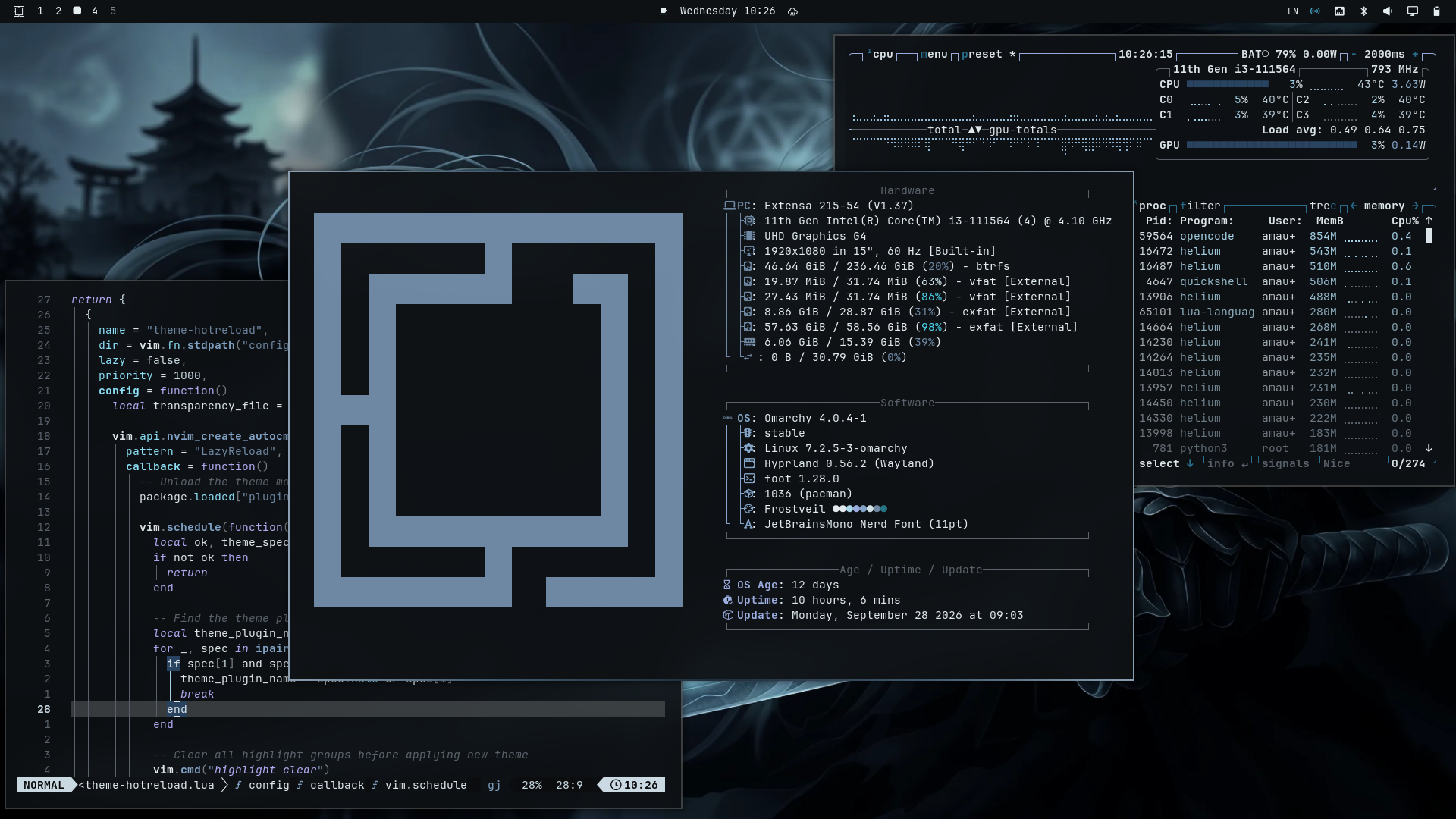
A dark Omarchy theme built around a single ice accent on a cool, almost-black base. The colour follows a strict lightness ramp (the philosophy of Solitude): grey-blue slots climb in luminance in clear steps, two slots carry real ice colour, and the bottom of the desktop stays dark so text always reads first. The active window border carries a gradient that fades through slate to the background at the centre of the edge, so windows read as lit at the corners and dim in the middle.
Palette
| Role | Colour |
|---|---|
| Background | #0e1114 |
| Foreground | #e4edf2 |
| Accent (deep ice) | #2c7190 |
| Selection bg / bright ice | #6bcee5 |
| Selection fg | #0e1114 |
| Muted | #5c646d |
| Dark surface | #2b4663 |
| Nord/ice (color4, color12) | #86a8cc / #c0d3ff |
| Ice standout (color1, color9) | #277789 / #4bd5ec |
colors.toml defines the sixteen color0–color15 slots; the named tokens
(red, green, yellow, blue, magenta, cyan) and their bright_
counterparts are resolved from them by Omarchy. Note that orange resolves to
the same value as yellow (#d1e1e9): the ramp has no separate orange slot,
and templates that ask for orange get the pale yellow.
The 16-colour ANSI ramp is defined in colors.toml and is what terminals, btop
and the shell all read, so editing colors.toml updates the whole desktop.
Every bright_* slot is genuinely lighter than its regular_* counterpart so
that bold text and TUI key hints stay legible, and no two of the sixteen slots
share a value, so neighbouring hues can never collapse into each other.
Lightness is not monotonic across color0–color7, and that is deliberate.
color3 (yellow) is the lightest slot in the normal range at Y≈0.73, because
yellow reads as a highlight when it is pale; the ramp then steps back down to
color4 (blue, Y≈0.37) before rising again through magenta and cyan to
color7. So color4–color7 is a strictly increasing run, and color1–color3
is another, with the yellow peak between them. Sorting the ramp by lightness
rather than by slot index is what keeps a TUI's "brightest" colours from
sitting in the middle of the scale. Neovim is generated from the same ramp,
see Neovim below.
Two ice blues
Frostveil carries two accent blues. The accent token is the deep ice
#2c7190: it is what app buttons read (omawrite, for example, paints its
primary button with the theme's accent and hardcodes white text), and white on
#2c7190 clears WCAG AA (5.42:1). The bright ice #6bcee5 is reserved for
surfaces that sit on the dark background, where it is the selection tint,
the polkit glyph, the launcher/menu selected text and the notification
countdown. The shell sections that must keep bright ice — [bar],
[notifications], [menu], [launcher], [polkit], [lock] and
[image-picker] — are pinned through shell..toml overrides, which
Omarchy merges into the generated shell.toml at theme-set time.
btop needs the same split, and for the same reason. Omarchy derives
btop.theme from colors.toml, but its own history says not to: the PR that
introduced the templates (4a07b94) reads "Bring back explicit btop themes —
they're too involved to derive from a basic color set", which is why lumon,
retro-82, last-horizon and solitude all ship their own. Derived, the
selected row resolves selected_fg = {{ accent }} on selected_bg =
{{ selection }}, i.e. #2c7190 on #2b4663 — 1.79:1, the worst of the 22
themes Omarchy ships. So btop.theme is shipped here, and it is the generated
file verbatim apart from the selection pair, which uses the
selection_background / selection_foreground tokens the template ignores:
#6bcee5 behind #0e1114, 9.55:1.
gtk.css follows the same split. GTK apps get accent_bg_color = deep ice
with a white label (accent_fg_color, 5.42:1), and their selection background
too, since Adwaita uses one colour for both the accent fill and text
selection. Accent-coloured text — links, labelled values — takes the bright
ice (accent_color) instead, because it sits on the dark background rather
than on the accent.
Note that the deep ice cannot carry a dark label: #0e1114 on #2c7190 is
only 3.49:1, which fails AA for body text. That is the whole reason the accent
is dark and paired with white.
Border gradient
The gradient lives in one field and drives both Hyprland windows and the shell's popups:
hyprland_active_border = "#8fa3b5 #3f5a70 #1a2736 #3f5a70 #8fa3b5"Dropping the trailing deg angle gives the horizontal default. 90deg is
vertical, 45deg diagonal. Note that Hyprland maps a linear gradient across the
whole window box, so 45deg and 0deg skew on non-square windows; the
horizontal default is the one that stays balanced across aspect ratios.
hyprland_active_border = "#8fa3b5 #3f5a70 #1a2736 #3f5a70 #8fa3b5"The centre stops drop toward the background so the gradient visibly fades across the edge — grey-blue steel at the corners, night in the middle, in the same desaturated family as Solitude's border.
Background
backgrounds/BG2.webp is an AI-generated glacial image whose visible colour
sits at hue ~241° (Nord), in the same cool family as the accent, with its
lighter area at the top of the screen where little sits. It is veiled (gamma
darkened to a mean luminance just above the theme background, 95% of pixels
below Y 0.085) so the wallpaper never competes with either the UI accent or
terminal text, and stored as WebP q82 (197 KiB) to keep the repository light.
Files
| File | Applies to |
|---|---|
colors.toml | source of truth, drives every template below |
hyprland.conf | window/decoration settings and colours |
hyprlock.conf | lock screen colours |
foot.ini | foot, the default Omarchy terminal |
alacritty.toml, ghostty.conf, kitty.conf, warp.yaml | other terminals |
gtk.css | GTK4 / Adwaita apps |
vencord.theme.css | Discord (Vencord) |
chromium.theme | Chromium/ungoogled-chromium window frame |
btop.theme | btop; shipped because the derived one loses the selected row (see Two ice blues) |
icons.theme | icon set (Yaru-prussiangreen-dark) |
walker.css, wofi.css, swayosd.css, waybar.css, mako.ini | shell surfaces |
shell.bar.toml | overrides the generated [bar] section in shell.toml (urgent/attention colour) |
shell.notifications.toml | overrides [notifications] (keeps the countdown on bright ice) |
shell.menu.toml | overrides [menu] (selected-text stays bright ice) |
shell.launcher.toml | overrides [launcher] (selected-text stays bright ice) |
shell.polkit.toml | overrides [polkit] (accent glyph stays bright ice) |
shell.lock.toml | overrides [lock] (input selection stays bright ice) |
shell.image-picker.toml | overrides [image-picker] (selected border stays bright ice) |
obsidian.css | Obsidian editor |
backgrounds/BG2.webp | desktop background |
preview.png | preview shown in the theme switcher |
Files that omarchy theme install does not copy
Omarchy deliberately drops a few files when installing a theme from a git repository, because they can name a program to launch. These files are in the repository for you to copy by hand, but installing the theme will not put them on your machine:
| File | Why it is skipped |
|---|---|
alacritty.toml, ghostty.conf, kitty.conf, foot.ini | terminal configs name the program to launch |
Everything else — colors.toml, backgrounds/, preview.png,
hyprland.conf, hyprlock.conf, the CSS files, chromium.theme,
btop.theme, icons.theme and the shell..toml overrides — is
installed normally and needs no manual step.
If you want the skipped ones, the instructions are below.
Neovim
Omarchy generates a Neovim spec from colors.toml on every omarchy theme set
and writes it to ~/.local/state/omarchy/current/theme/neovim.lua. That spec
drives aether.nvim — bg, fg,
muted, selection, the full ANSI ramp and the accent — so the editor is
coloured straight from this palette rather than from a second one kept in sync
by hand.
Nothing installs that spec for you, because it belongs to your Neovim config. Point LazyVim at it with a symlink:
ln -sf ~/.local/state/omarchy/current/theme/neovim.lua \
        ~/.config/nvim/lua/plugins/theme.lua
The name matters. Omarchy's omarchy-theme-hotreload.lua looks for
plugins.theme to re-colour the editor when you switch themes, so a symlink
named anything else (an older plugins/neovim.lua, say) silently disables
hot-reloading. With the symlink in place, LazyVim/LazyVim picks up
colorscheme = "aether" from the spec and the editor follows the desktop.
Restart Neovim afterwards. If Aether does not appear, run :Lazy sync once.
If you prefer a colorscheme that stands apart from the UI, delete the symlink
and set your own colorscheme in ~/.config/nvim/lua/plugins/ instead.
Terminals
The terminal configs are not installed automatically. Each one is a drop-in file you copy to the right place. You only need the one for the terminal you use.
foot (Omarchy's default)
foot.ini is a complete standalone config: the full Frostveil palette plus a
translucent blurred background, an 11pt JetBrainsMono Nerd Font, a beam cursor
and 10 000 lines of scrollback.
THEME=~/.config/omarchy/themes/frostveil
mkdir -p ~/.config/foot
cp "$THEME/foot.ini" ~/.config/foot/foot.ini
omarchy restart terminal
Because a theme-supplied foot.ini is never regenerated, editing
colors.toml will no longer update foot — the palette in foot.ini is a
copy. If you change the palette, mirror it in the [colors-dark] section of
your foot.ini too.
Prefer to keep foot tied to the palette? Delete foot.ini from your copy of
the theme. Omarchy then regenerates it from colors.toml on every
omarchy theme set, and you can still get the look by adding just the
presentation settings to ~/.config/foot/foot.ini:
[main]
include=~/.local/state/omarchy/toggles/foot.ini
include=~/.local/state/omarchy/current/theme/foot.ini
term=xterm-256color
font=JetBrainsMono Nerd Font:size=11
pad=14x14
initial-window-mode=windowed
workers=0

[colors-dark]
blur=yes
alpha=0.95

[scrollback]
lines=10000
multiplier=7.0

[cursor]
style=beam
blink=yes
This second form is the more flexible one: colours stay generated from
colors.toml, and only the presentation is yours.
Other terminals
THEME=~/.config/omarchy/themes/frostveil

# Alacritty
mkdir -p ~/.config/alacritty && cp "$THEME/alacritty.toml" ~/.config/alacritty/

# Ghostty
mkdir -p ~/.config/ghostty && cp "$THEME/ghostty.conf"    ~/.config/ghostty/config

# Kitty
mkdir -p ~/.config/kitty && cp "$THEME/kitty.conf"        ~/.config/kitty/

# Warp
mkdir -p ~/.config/warp-terminal/themes && cp "$THEME/warp.yaml" ~/.config/warp-terminal/themes/
Look'n'feel
Omarchy does not source hyprland.conf automatically. Hyprland reads the
generated hyprland.lua, which already carries the border gradient, so the
theme alone gives you the palette and the border. The rest of the look'n'feel —
gaps, blur, shadows, dimming, tearing — is in hyprland.conf and has to be
applied by you.
The settings it carries are:
| Setting | Value |
|---|---|
| Gaps | gaps_in = 4, gaps_out = 8 |
| Border size | border_size = 2 |
| Blur | size = 10, passes = 2, new_optimizations = true |
| Shadow | range = 16, color = rgba(00000052) |
| Motion blur | enabled |
| Dim inactive | dim_inactive = true, dim_strength = 0.5 |
| Tearing | allow_tearing = true |
| Layout | dwindle |
| Rounding | not forced (Omarchy's default) |
You have two ways to apply them.
Option A — source the file. Add this to the bottom of
~/.config/hypr/hyprland.lua, after the Omarchy requires:
source = (os.getenv("HOME") .. "/.config/omarchy/themes/frostveil/hyprland.conf")Option B — copy the settings. Add them to
~/.config/hypr/looknfeel.lua, which Omarchy already loads for you. This is
the tidier option because it keeps your own config self-contained:
hl.config({
  general = {
    allow_tearing = true,
    gaps_in = 4,
    gaps_out = 8,
    border_size = 2,
  },
  decoration = {
    motion_blur = { enabled = true },
    blur = {
      enabled = true,
      size = 10,
      passes = 2,
      new_optimizations = true,
    },
    shadow = {
      enabled = true,
      range = 16,
      color = "rgba(00000052)",
    },
    dim_inactive = true,
    dim_strength = 0.5,
  },
})
Then reload Hyprland:
hyprctl reloadLock screen. hyprlock.conf only defines colours. Source it from your own
hyprlock config to get a matching lock screen:
source = ~/.config/omarchy/themes/frostveil/hyprlock.confInstall
omarchy theme install frostveilOr from the URL directly:
omarchy theme install https://github.com/amaurisd97/omarchy-frostveil-theme.gitThen apply it:
omarchy theme set "Frostveil"Cycle through the bundled background with omarchy theme bg next.
Credits
- The original file layout and the general structure come from Vengeance by Grey-007.
- The ramp philosophy — a desaturated palette separated by strictly increasing lightness rather than by hue — follows the stock Solitude theme.
- Neovim is coloured by aether.nvim from the generated spec, not by a dependency bundled here.
- The wallpaper was generated with AI image tools and is released under the same MIT license as the theme.
License
MIT. See LICENSE, and NOTICE for the credits that go with it.